This content is not available in your region
TBA55-What the Hopi Said About the Stone Trees of the Painted Desert Documented in 1894 - The Buried Archive
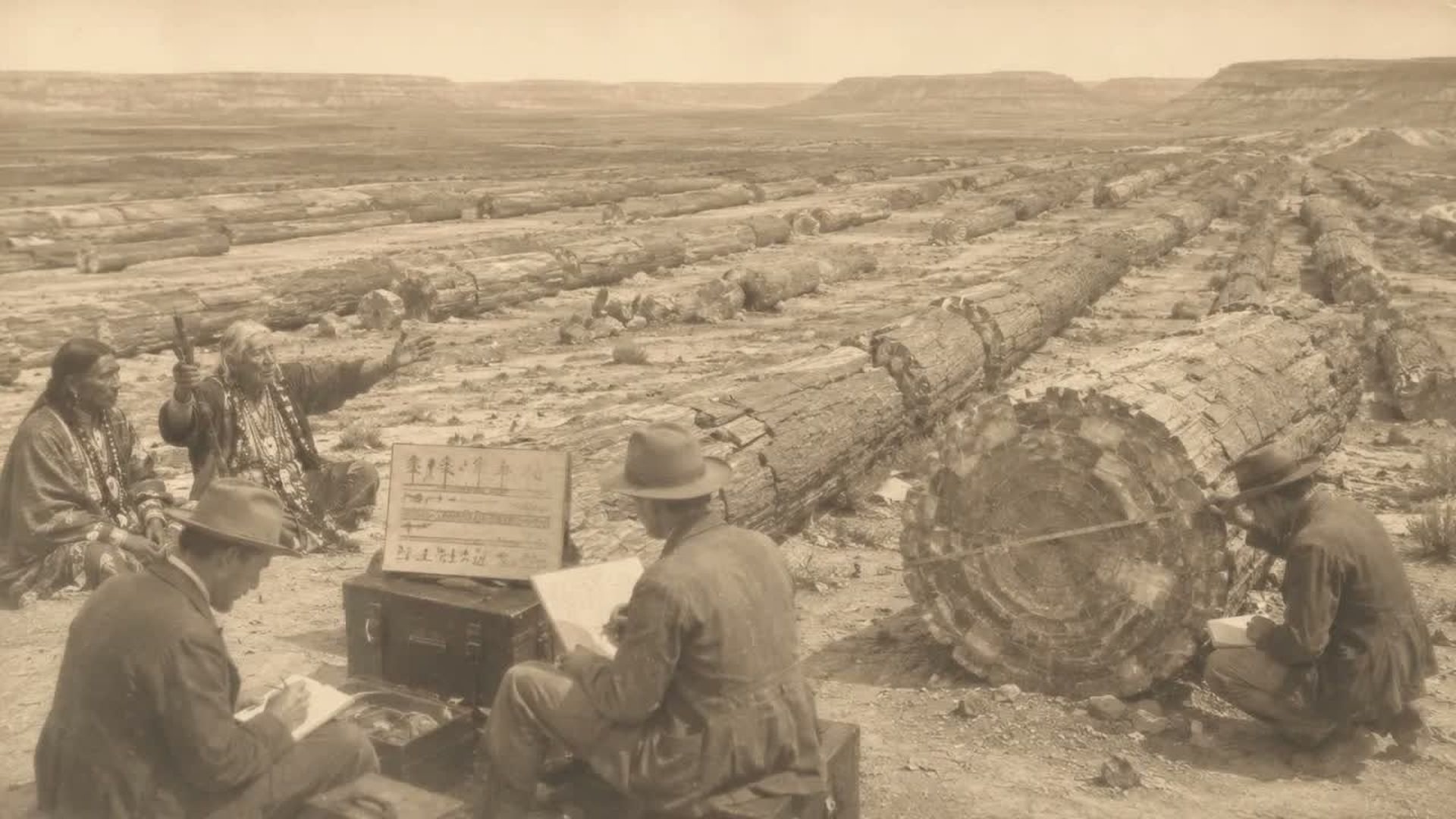
In 1894, John Hewitt's journey into Arizona's Painted Desert revealed an astounding account from the Hopi people about petrified trees—a narrative deemed too outside conventional understanding to maintain a place in history. The Hopi referred to these stone trees as Yaya Tukwawi, translating to the staff poles of Yaya, linked to ancient supernatural beings. They asserted these weren't mere petrified wood; instead, they were colossal structural remnants from a bygone civilization, left behind after a catastrophic event that transformed their original material into crystalline forms. This striking contrast between Hopi cosmology and mainstream geological interpretations raises compelling questions: Were these artifacts created or merely victims of natural processes? The Hopi's perspective speaks to a reality far richer than typical geological narratives. They viewed the painted landscape not as an empty space, but as a ruin field filled with the traces of an ancient world that predates their current existence. Geological explanations fail to account for the peculiarities of the petrified logs—such as their lack of stumps, the complete silicification process, and the color variations that suggest rapid, extreme events rather than gradual sedimentation. Traditional narratives often overlook these flaws, preferring models that adhere to orthodox timelines and processes. Yet, the Hopi's unyielding oral traditions tell a consistent story: the logs are remnants of civilization, intricately tied to their historical memory and cultural significance. Even more intriguingly, this understanding aligns with broader theoretical frameworks like the Tartarian hypothesis, suggesting historical gaps relevant to ancient civilizations have been systematically overlooked or erased. Walking through the lens of the Hopi narrative, what do these stone trees reveal about humanity's forgotten past? When narratives converge across cultures, as evidenced by similar accounts globally, one must question whether these are independent interpretations or echoes of a singular catastrophic event preserved in collective memory. As we delve deeper into Hewitt's record, we confront a foundational quandary of our understanding: What came before? The persistent question arises—is this forgotten history the key to uncovering a more nuanced, complex narrative of human civilization?
Categories: Entertainment